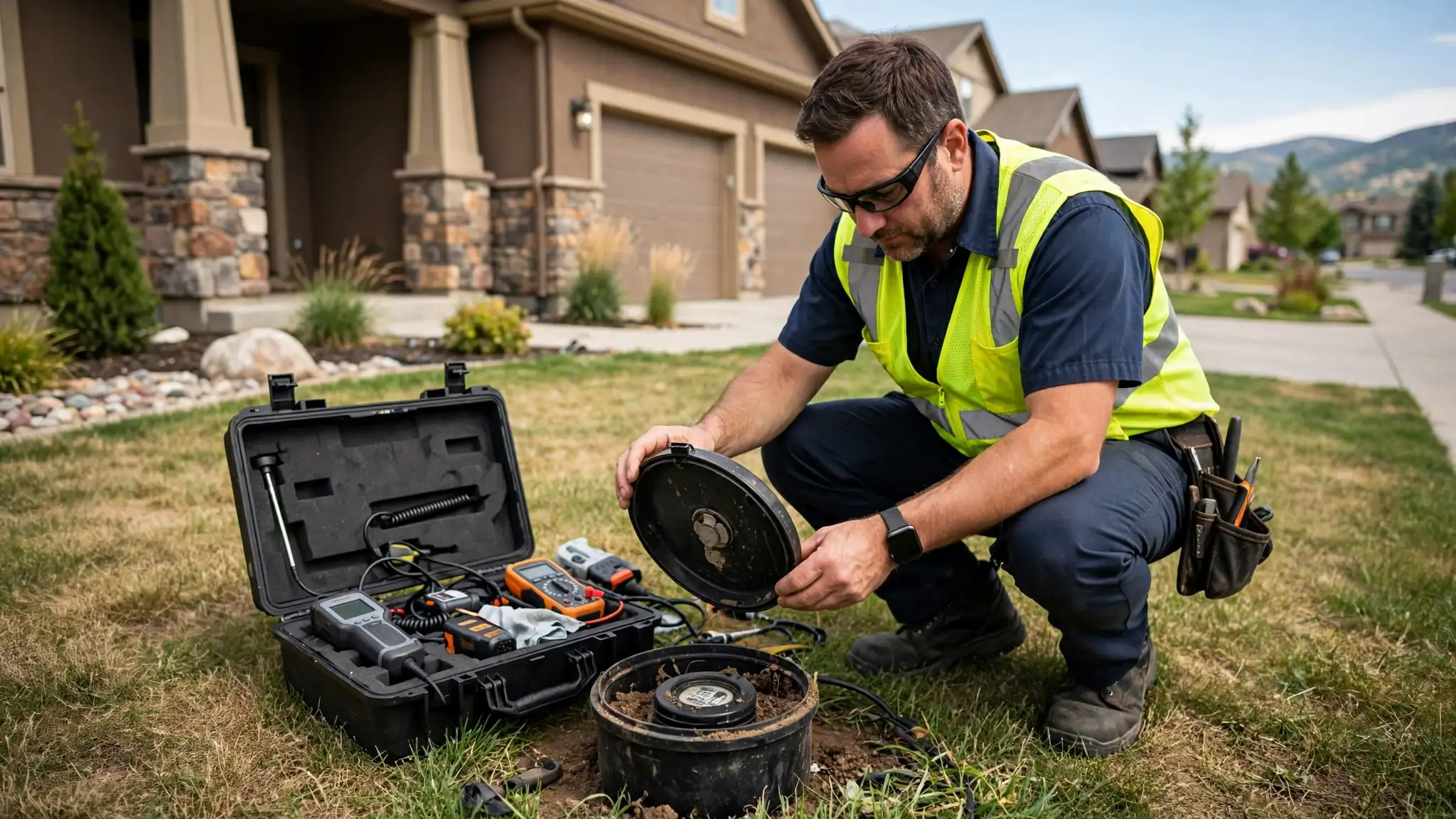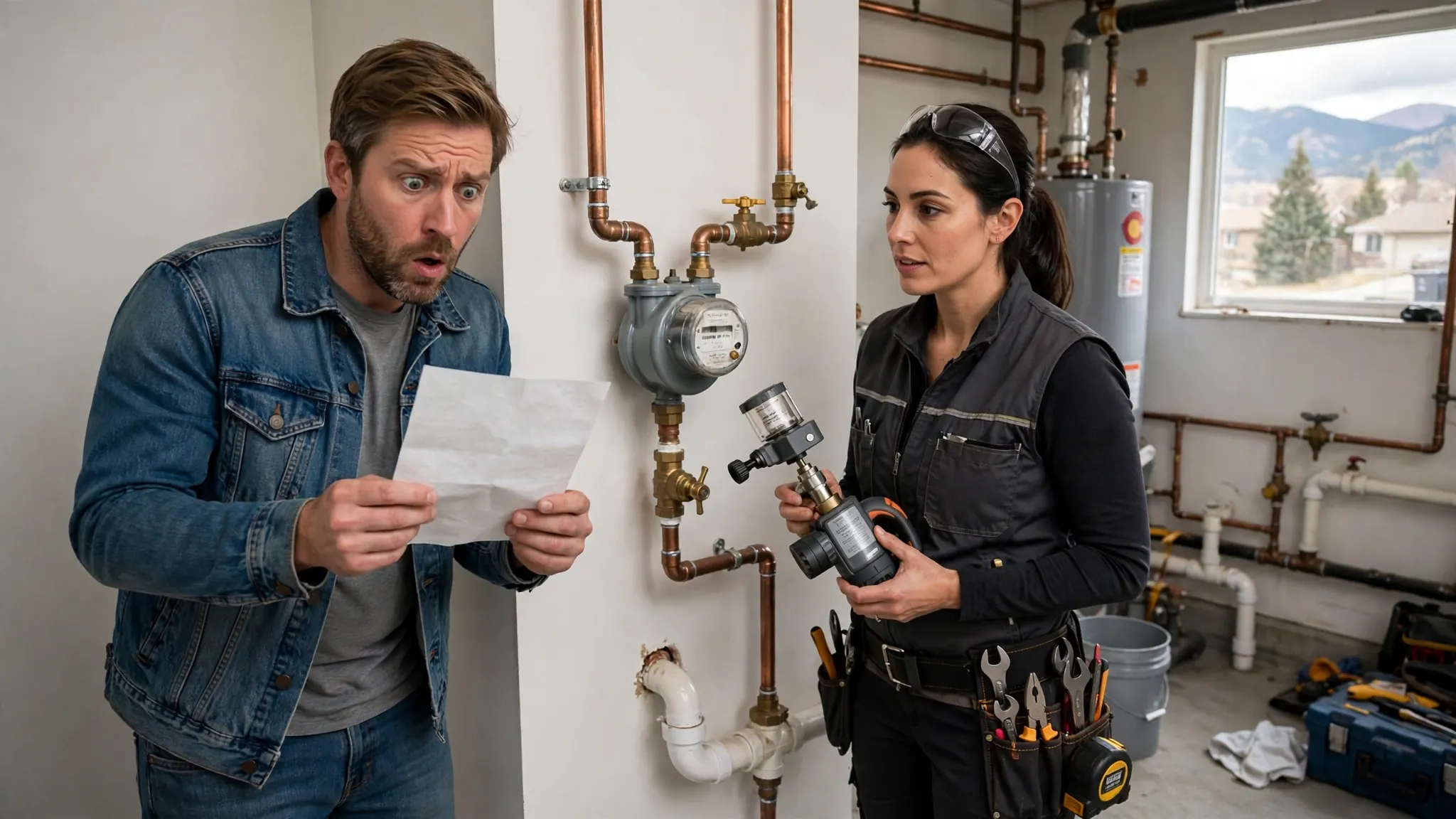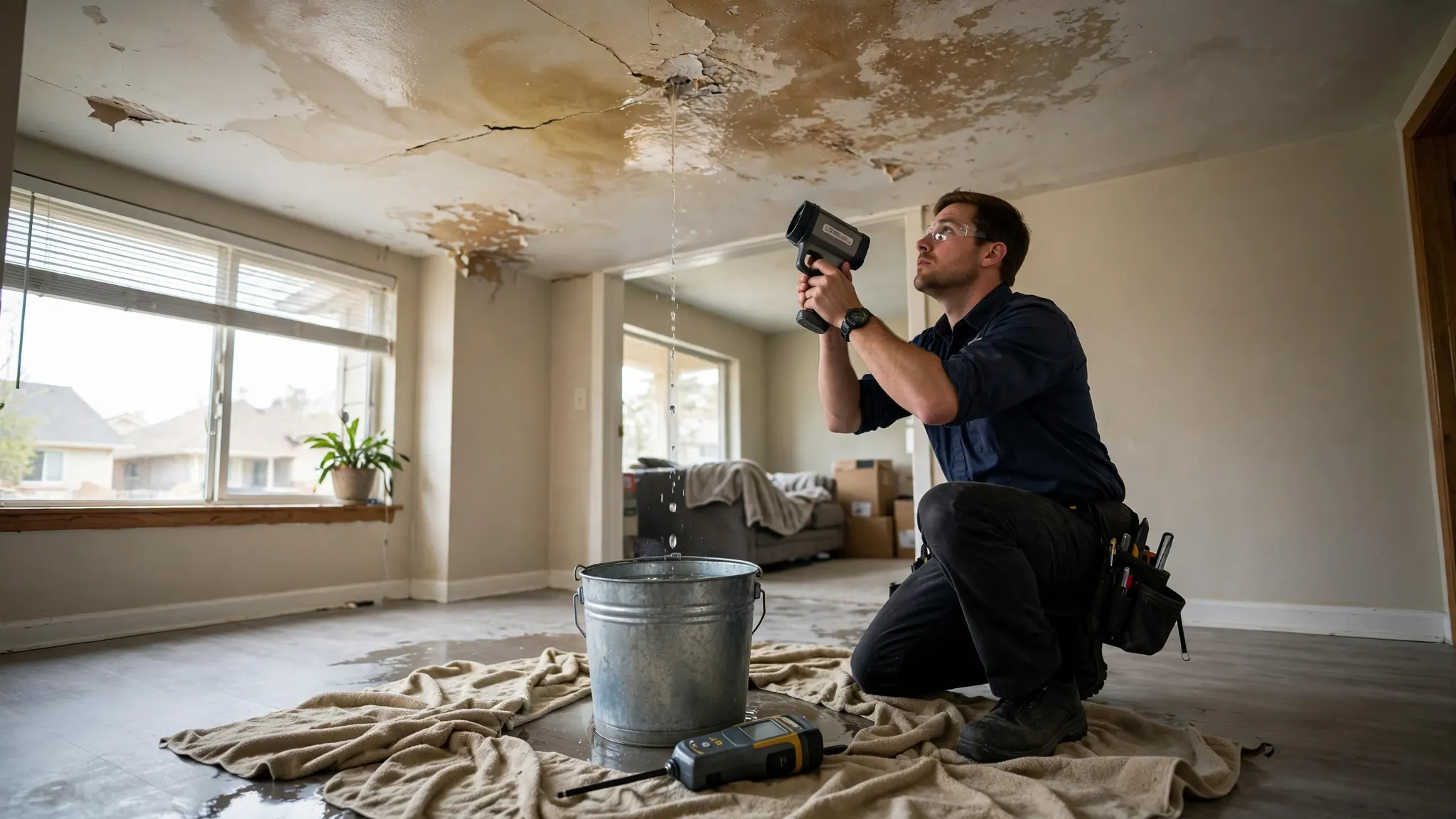
An active leak compresses your decision-making into minutes: stop the water, protect people and property, and get a professional rolling toward you — in that order. The steps below are the ones that actually reduce damage in the window between discovery and the arrival of the detection truck. Because 80038 is a PO-box-only postal zone, we treat it as general Broomfield service-area coverage: if your mailing address says 80038, you're inside our dispatch zone, and our leak detection team for the 80038 area answers 24/7 with 30–45 minute arrival. Read the first section now; the rest can wait until the water is under control.
The First Five Minutes: Stop The Water
Every emergency starts at a valve. If the leak is at a single fixture — a toilet supply line, a sink connection — turn the fixture's own shutoff valve clockwise until it stops; those small oval or lever handles sit on the supply lines beneath the fixture. If you can't find a fixture valve, or water is coming from a wall, ceiling, or floor, go straight to the main shutoff and turn off the whole house. Don't spend ten minutes hunting for the perfect valve while water spreads.
Know where your main shutoff is before the emergency. In most Broomfield homes it's where the water line enters the house — often the garage wall, a utility closet, or the basement — or at the meter box near the curb. If you've never touched yours, go look today; valves that sit untouched for years can seize, and discovering that at 2 a.m. with water on the floor is the worst possible timing. If the valve won't budge, don't force it with a wrench hard enough to snap the pipe — call us and we'll talk you through the meter-side shutoff.
For a suspected ceiling leak or wall leak, shutting the water off halts the active damage even though it doesn't fix the broken pipe. A bulging ceiling full of trapped water can be punctured to drain it in a controlled way — a small hole with a bucket underneath beats a spontaneous collapse — but only after the water is off and the power to that area is cut.
Protect People And Property
Water and electricity are the dangerous combination; everything else is just money. If water is near outlets, switches, light fixtures, or the breaker panel, cut power to the affected area at the breaker before stepping into standing water. Don't unplug devices sitting in water — kill the circuit first.
Then move what matters: electronics, documents, rugs, and furniture out of the water's path. Slide aluminum foil or plastic under furniture legs you can't move — it won't save the carpet, but it keeps stain and rust off the wood. For carpeted areas, lift what you can and get air moving; a box fan pointed at the wet area starts the drying process long before any professional equipment arrives.
Start documenting immediately. Photograph the leak source, the spread, and anything damaged — wide shots for context, close-ups for detail. These photos serve two purposes: they help our technician triage your call, and they become evidence for your insurer. A quick phone video narrating what happened and when is worth more than a perfect memory later.
What Not To Do
Panic decisions cause a surprising share of secondary damage. Avoid these:
- Don't tear open walls or ceilings to "find it." Demolition without a pinpoint is how a one-foot repair becomes a four-foot patch job. Our instruments locate the leak non-invasively — let them.
- Don't keep using fixtures on the affected line. Running water upstream of a break feeds it. Once the water is off, leave it off until the source is located.
- Don't ignore a small leak because it's 2 a.m. Small leaks at night become large repairs by morning. We answer 24/7 precisely because water doesn't keep business hours.
- Don't pour chemical drain products into a leak situation. They don't fix supply leaks, and they make the work area hazardous for the technician.
- Don't stand in water to flip breakers or move appliances. Cut power from a dry location, or wait. No possession is worth an electrical injury.
While The Truck Rolls
Once you've called (720) 715-9734 and the crew is dispatched — typically arriving in 30–45 minutes — use the wait productively. Clear a path to the suspected area: move boxes out of the utility closet, unlock the side gate if the meter box is outside, crate the dog. Every minute the technician spends waiting on access is a minute water keeps working.
Gather the facts we'll ask about: when did you first notice it, is it getting worse, what did you shut off, and where is the water meter? If your water meter is accessible, a glance at whether it's still spinning with everything off tells us whether the leak is on your side of the meter — useful triage that takes ten seconds. Our guide to a spinning meter with no water running walks through the check if you've never done it.
Emergencies go smoother when the number is already in your phone. Save (720) 715-9734 now — 24/7 emergency leak detection across greater Broomfield, including the full 80038 postal zone, with 30–45 minute arrival.
What Happens When We Arrive
Our emergency leak detection visit starts with a fast assessment: confirm the water is off, map where water traveled versus where it originated — those are often different places — and choose the right instruments for the situation. Acoustic listening for pressurized supply leaks, thermal imaging for hot-water lines and moisture spread, pressure isolation to confirm which pipe section is compromised.
Everything is non-invasive. We don't open walls to find the leak; we open walls (or rather, your repair plumber does) only after the pinpoint is established. You'll get a clear verbal finding on site — where it is, what failed, and what the repair path looks like — followed by a written report with images and readings for your records and your insurer.
With 25 years in this work and an average rating of 4.9 out of 5 across more than 250 customer reviews, our crews have handled the full catalog of Broomfield emergencies: burst supply lines in freeze events, slab leaks that surfaced as warm floor spots, service lines that failed silently for months. The pattern is always the same — fast stop, fast find, clear next step.
After The Emergency Visit
Once the leak is located, the urgent phase is over and the repair phase begins. Our report gives your plumber the exact location, which keeps the repair targeted and the patch small. Keep all documentation — photos, our report, repair invoices — together; insurers ask for a complete paper trail, and organized paperwork shortens claim reviews.
Then fix the root vulnerability, not just the symptom. If a frozen pipe burst, the insulation or heat-tape question matters more than the new pipe. If a supply line failed from age, ask what else in the house is the same age. And if this emergency taught you where your main shutoff is, label it and show everyone in the household — the next five-minute response starts with knowledge, not panic. If water is spreading right now, don't finish this article: call (720) 715-9734.